Why Topical Teachings Can Be Misleading
Gathering verses around a topic can produce a conclusion the biblical writers never intended. John 14:13–14 is a case in point.
 M.A. CosgroveReasoning Together
In this article
A teaching can contain many Bible verses and still misrepresent what the Bible says. This happens when passages are gathered around a topic without first establishing what each passage means in its original setting. The quotations may be accurate, but the argument assembled from them may be something the biblical writers never intended.
Verses become surprisingly pliable when we pull them out of their immediate context and the larger discussion (discourse) to which they belong. Detached from those connections, they can seem to support ideas that the surrounding passage resists or even rules out. We have kept the words but lost the connections that help us understand them.
In Grasping God’s Word, J. Scott Duvall and J. Daniel Hays explain how this happens in topical preaching. They recognize that teaching by topic is legitimate, provided each passage is understood in context and the message respects those contexts. The danger comes when a teacher moves between passages, joining statements from separate discussions into a message of the teacher’s own choosing.[1] Listeners hear one biblical reference after another and reasonably assume the conclusion must be biblical too.
But the number of references cannot settle that question. A Bible verse can be quoted accurately and used badly.
A test case: John 14:13–14
Consider John 14:13–14 (KJV):
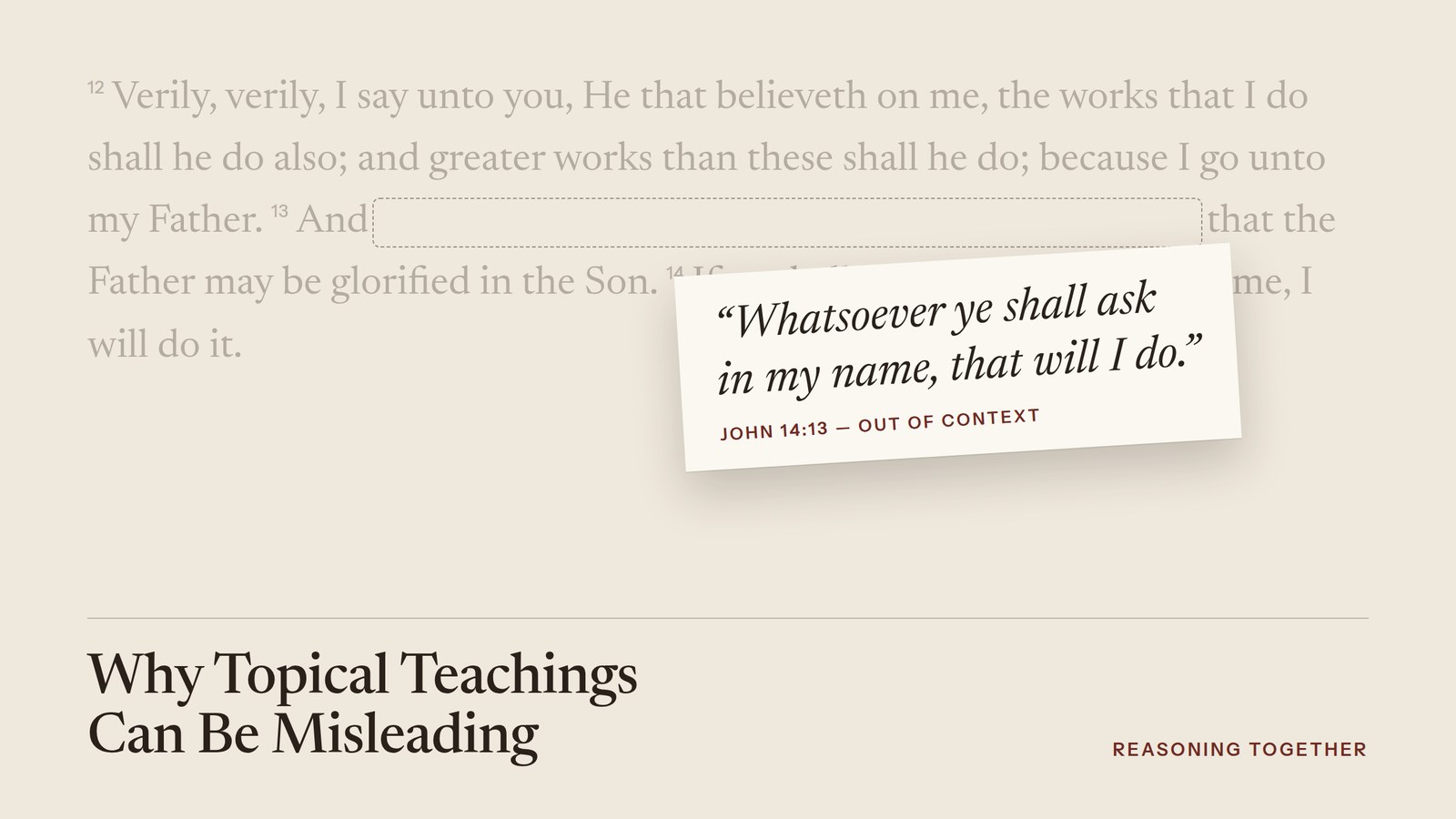
And whatsoever ye shall ask in my name, that will I do, that the Father may be glorified in the Son. If ye shall ask any thing in my name, I will do it.
Read on its own, this can sound like a blank check. Ask for whatever you want, add “in Jesus’ name,” and the result is guaranteed. It is easy to see the appeal, especially when someone desperately needs help.
The setting
To understand the promise, we need to follow the conversation in which Jesus makes it.
He is speaking to his disciples during the farewell discourse associated with the Last Supper. His death and departure are approaching. They will have to continue his work without his physical presence, and he is preparing them for that. Immediately before the promise about prayer, he says in John 14:12 (KJV):
Verily, verily, I say unto you, He that believeth on me, the works that I do shall he do also; and greater works than these shall he do; because I go unto my Father.
Then comes “And whatsoever ye shall ask in my name.”
That “And” connects the promise to what Jesus has just said. His followers will continue his work, and they can ask for God’s help as they do so. The connection between their work and his is plain. The promise about prayer belongs within that setting.
What “in my name” means
“In my name” carries weight here. It involves agency—acting on someone else’s behalf. A representative receives authority from another person and answers to that person’s purposes. Being authorized to represent someone does not give us permission to do whatever we happen to prefer.
A modern power of attorney offers a limited comparison. It grants authority within a defined scope. The person exercising it cannot enlarge that authority simply by wanting something outside it.
Similarly, invoking Jesus’ name cannot give his authorization to a request merely because we have made it.
His name refers to the person himself: his character, authority, teaching, and purposes. To ask in his name is to depend on him while seeking to act faithfully on his behalf. Saying “in Jesus’ name” at the end of a prayer should express that dependence; the words cannot substitute for it.
The stated purpose
Jesus also tells his disciples why that kind of prayer will be answered: “that the Father may be glorified in the Son.” We cannot read “whatsoever” apart from Jesus’ stated purpose: that the Father may be glorified in the Son. A request driven by selfishness does not become guaranteed because we have attached Jesus’ name to it.
The larger discourse
As the conversation continues, Jesus says in John 15:7 (KJV):
If ye abide in me, and my words abide in you, ye shall ask what ye will, and it shall be done unto you.
Here, asking grows out of abiding in him and having his words remain in his followers. That relationship shapes what they want and what they seek. A little later, Jesus connects asking with the work he has given them. John 15:16 (KJV) reads:
Ye have not chosen me, but I have chosen you, and ordained you, that ye should go and bring forth fruit, and that your fruit should remain: that whatsoever ye shall ask of the Father in my name, he may give it you.
They have been chosen to go and bear lasting fruit. Within that calling, they are invited to ask the Father in Jesus’ name. Asking, representing him, and bearing fruit belong together throughout the conversation.
Having followed that connection within John’s Gospel, we can consider a related passage in 1 John 5:14 (KJV):
And this is the confidence that we have in him, that, if we ask any thing according to his will, he heareth us.
Here the connection with God’s will is explicit. Believers can pray confidently as they seek what accords with His purposes. This supports the reading that emerges from Jesus’ own words in John 14–15.
None of this excludes prayer for personal needs. Our needs matter, and bringing them to God may be entirely consistent with His will. The difficulty comes when we turn Jesus’ assurance into a guarantee of whatever outcome we choose. In this passage, he promises continuing help to those who represent him and carry on his work to the Father’s glory.
Why this matters
Getting this wrong can hurt people.
Someone may pray sincerely, expecting a result they have been taught Jesus guarantees. When it does not come, they wonder whether their faith was too weak. Perhaps they begin to doubt God’s faithfulness. They are left trying to explain why God failed to keep a promise He may never have made to them in that form.
That is a heavy burden to place on someone through careless reading.
Reading responsibly
Responsible topical teaching takes time to hear each biblical writer before bringing passages together. Who is speaking, and to whom? What situation is being addressed? What comes before these words, and what follows? How does this passage contribute to the larger discussion?
Those questions give us a sound basis for connecting passages. They also leave room for Scripture to challenge what we expected to find.
Before asking how a verse supports our topic, we must ask what it contributes to the biblical writer’s own argument. We may have to change the teaching we planned to give.
That is a good reason to read carefully.
Notes
J. Scott Duvall and J. Daniel Hays, Grasping God’s Word: A Hands-On Approach to Reading, Interpreting, and Applying the Bible, 4th ed. (Grand Rapids: Zondervan Academic, 2020), chap. 8, “The Literary Context,” subsection “Topical Preaching.” ↩︎
Get new articles by email
One short email when something new is ready: an article, an episode, a class opening, or a book release. No more than that.
Subscribe
Comments
Comments on this article are now closed. You are always welcome to reply to any of our emails.