We Celebrate the Reformation. But Would We Welcome a Reformer?
Every Reformation Sunday we honour a man who challenged the orthodoxy of his day. The harder question is whether our own churches would make room for the same questions.
 M.A. CosgroveReasoning Together
In this article
Every Reformation Sunday, Protestant churches remember a man who dared to challenge the religious establishment of his day. We celebrate his courage, his conviction, and his refusal to surrender what he believed Scripture taught simply because those in authority disagreed.
But there is an uncomfortable question worth asking: Would we welcome Martin Luther into our churches today? Or would we regard him as a troublesome dissenter, someone whose questions threatened the unity of the congregation?
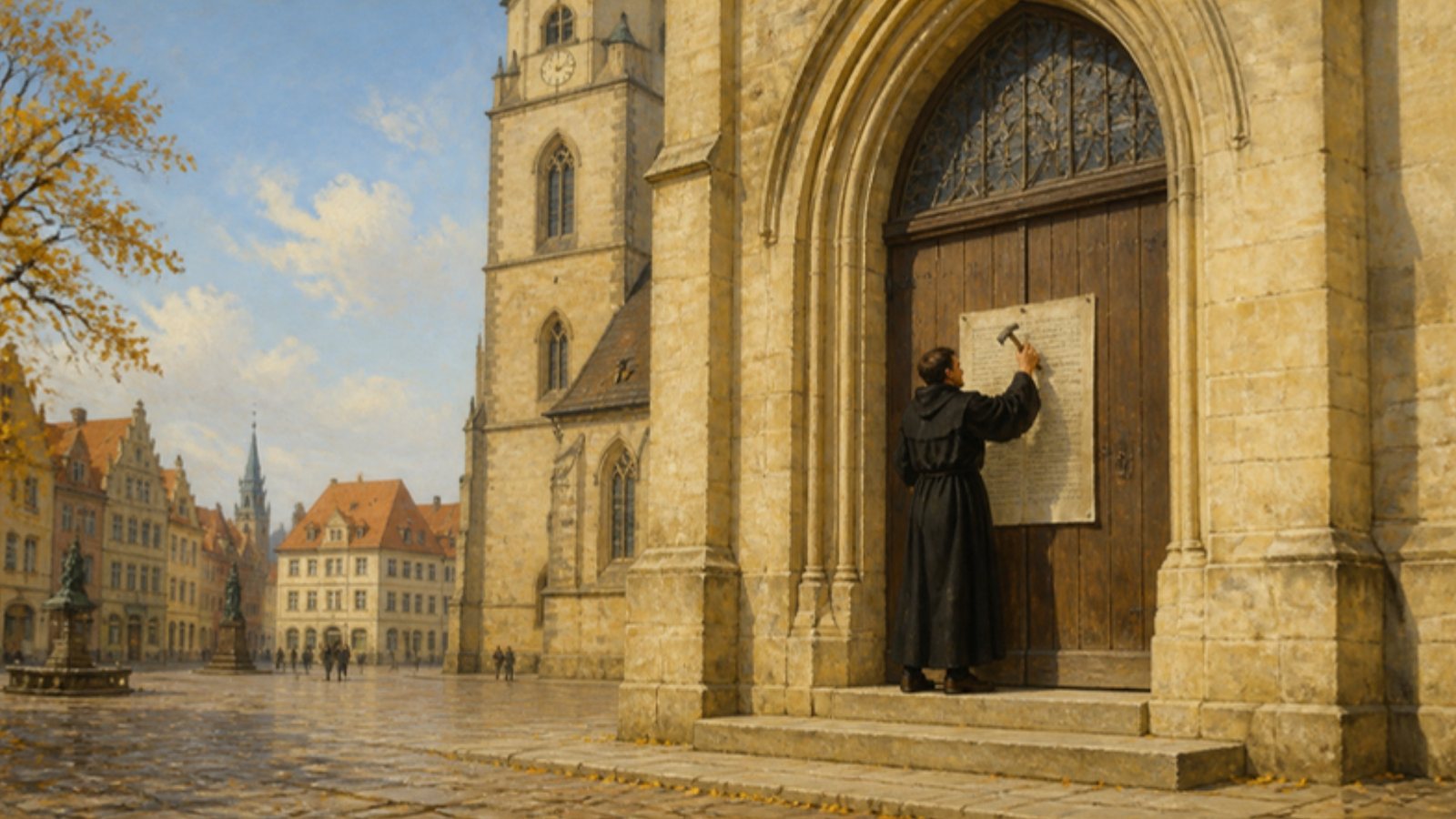
On October 31, 1517, Luther, then a Catholic monk and professor of theology, circulated ninety-five propositions questioning the church’s teaching and practices concerning indulgences.[1] Tradition remembers him hammering those theses onto the door of the Castle Church in Wittenberg. Whether he personally nailed them there remains debated.[2] What is beyond dispute is his invitation to theological examination.

His propositions began with a statement of purpose:
“Out of love for the truth and a desire to bring it to light.” Martin Luther, 1517
Luther was inviting discussion.[3] He was asking that established teaching be examined and defended. He had not set out to establish a new denomination. The questions he raised, however, eventually brought him into direct conflict with ecclesiastical authority. In 1521, he was excommunicated.
Five centuries later, churches that owe their existence to the Reformation celebrate the man who refused to accept the religious consensus of his time.
The irony should not escape us. We honour the courage of those who challenged yesterday’s orthodoxy, yet we can become remarkably uncomfortable when someone challenges our own.
When Unity Becomes More Important Than Truth
Christian unity is a biblical responsibility. Jesus prayed that his followers would be one (John 17:21). Paul urged believers to preserve the unity of the Spirit in the bond of peace (Ephesians 4:3). These are not suggestions we can dismiss when disagreements become inconvenient.
But neither can we separate unity from the truth upon which it is meant to rest.
In the same prayer in which Jesus spoke of unity, he prayed:
“Sanctify them through thy truth: thy word is truth.” John 17:17 (KJV)
Paul likewise describes Christian maturity as a movement toward unity in the faith and in the knowledge of the Son of God (Ephesians 4:13). His instruction to speak the truth in love (Ephesians 4:15) joins two obligations that we are sometimes tempted to separate.
Unity and truth are not competing virtues. Genuine Christian unity is strengthened by a shared commitment to discovering and following what God has revealed.
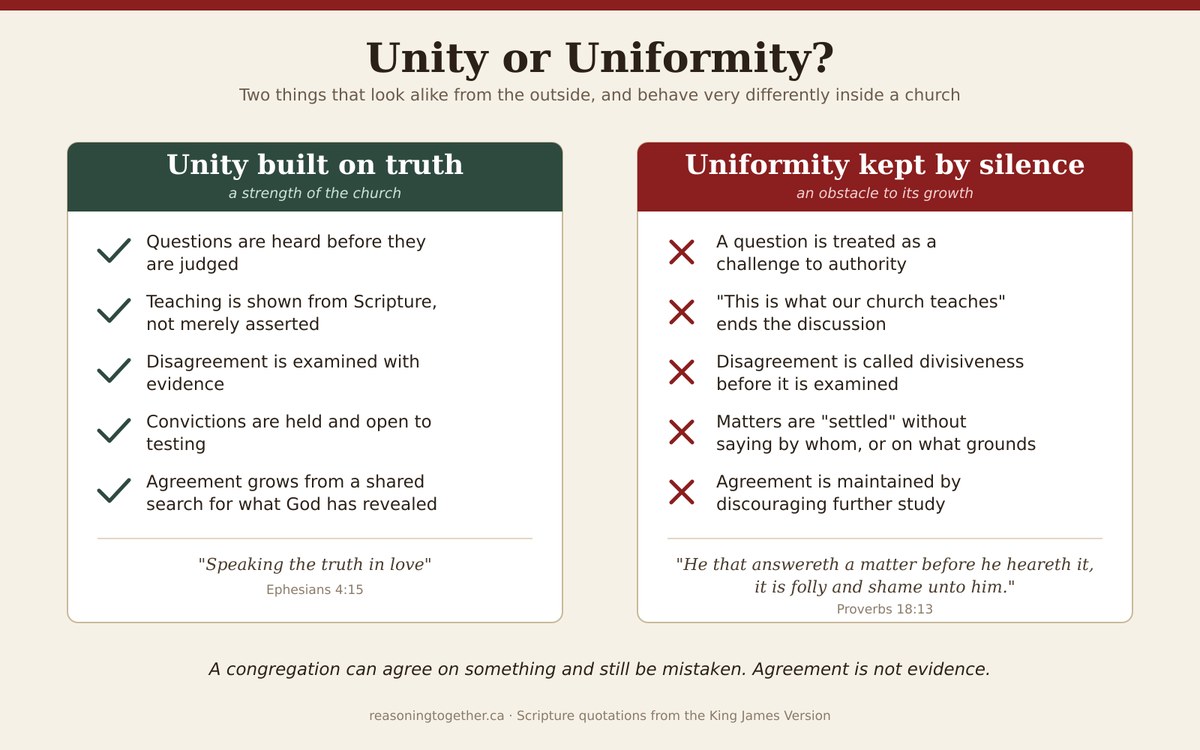
The difficulty arises when unity is redefined as agreement with an institution’s existing interpretations. Under that arrangement, a question becomes a challenge to authority, disagreement becomes divisiveness, and further examination of Scripture is treated as unnecessary because the matter has supposedly been settled.
But who settled it? On what grounds? And what happens when someone presents evidence from Scripture that calls the prevailing interpretation into question?
If the answer is that the discussion itself threatens unity, we have exchanged the pursuit of truth for the preservation of consensus.
A congregation can agree on something and still be mistaken. Agreement is not evidence that an interpretation is correct. A thousand people repeating the same misunderstanding do not make it true. They merely make it popular.
There is a difference between unity built upon truth and uniformity maintained by discouraging questions. The former is a strength of the church. The latter can become an obstacle to its growth.
The Bereans Had a Better Idea
The book of Acts gives us a remarkable example of how believers ought to respond when confronted with teaching they have not previously considered.
When Paul and Silas arrived in Berea, the people received their message. Luke tells us:
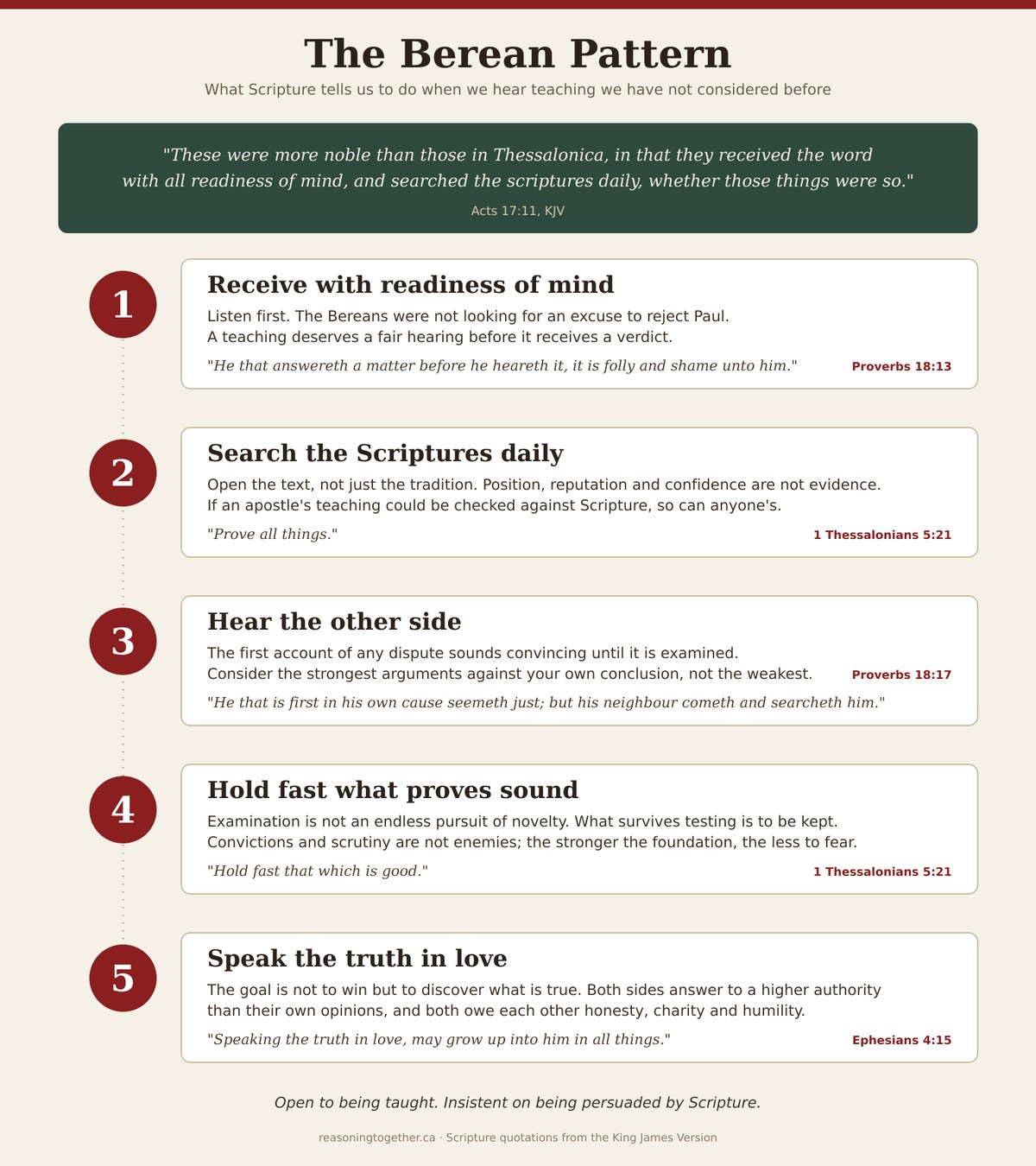
“These were more noble than those in Thessalonica, in that they received the word with all readiness of mind, and searched the scriptures daily, whether those things were so.” Acts 17:11 (KJV)
Consider what was happening.
The apostle Paul was teaching. Yet the Bereans did not accept his message simply because of his position, reputation, or confidence. They examined the Scriptures to determine whether his teaching was correct.
And Luke commended them for it.
There was no suggestion that their examination demonstrated a rebellious attitude. Quite the opposite. Their willingness to listen, combined with their determination to verify what they heard, was evidence of noble character.
Notice the balance. They received the message with readiness of mind. They were not looking for an excuse to reject Paul. Neither were they prepared to surrender their responsibility to examine his teaching.
If the Bereans were commended for examining the teaching of an apostle, why should Christians today be discouraged from examining the teaching of a pastor, theologian, denominational leader, or doctrinal committee?
Surely no modern minister possesses greater authority than Paul.
The Berean example places a responsibility upon both teacher and student. The teacher must be willing to demonstrate the scriptural foundation of what is taught. The student must be willing to listen carefully and examine the evidence fairly.
Neither is entitled to substitute authority, familiarity, or personal preference for the Word of God.
When Paul Challenged Peter
The New Testament offers an even more uncomfortable example.
In Galatians 2, Paul recounts confronting Peter at Antioch. Peter had withdrawn from eating with Gentile believers because of pressure from those associated with the circumcision group. His behaviour influenced others, including Barnabas.
Paul did not remain silent for the sake of harmony.
He writes:
“I withstood him to the face, because he was to be blamed.” Galatians 2:11 (KJV)
The matter was not an insignificant personal disagreement. Paul recognized that Peter’s conduct compromised the truth of the gospel. In verse 14, he explains that they were not walking uprightly according to that truth.
Here were two apostles, both recognized as leaders in the early church, standing in disagreement over a matter that affected Christian fellowship.
Imagine someone appealing to Paul to leave the matter alone. Think of the damage to unity, they might have argued. Think of the confusion among the believers. Surely there must be a way to preserve peace without publicly confronting Peter.
Yet Paul understood that allowing the error to continue would itself damage the church.
He did not oppose Peter because he rejected unity. He opposed him because the truth upon which their fellowship rested was being compromised.
That distinction matters.
Sometimes disagreement threatens unity because of pride, ambition, or an unwillingness to listen. At other times, disagreement arises because someone has recognized a genuine problem that others have overlooked or are unwilling to address.
We should be careful not to confuse the two.
The Protestant Tradition of Challenging Orthodoxy
The Protestant Reformation was not simply a disagreement about the sale of indulgences. It developed into a profound examination of church authority, salvation, grace, and the proper interpretation of Scripture.
At its centre stood a question: By what authority does the church establish its doctrines?
The Reformers did not argue that Christians should disregard two thousand years of theological reflection. They challenged the assumption that established ecclesiastical interpretations were beyond correction by Scripture.
The distinction is fundamental.
Tradition can preserve the accumulated wisdom of generations. Creeds and confessions can articulate truths that the church has studied, defended, and passed down through centuries. We would be foolish to dismiss that inheritance simply because it is old.
But age does not make an interpretation infallible.
The Protestant principle of sola Scriptura places Scripture above the church’s interpretive traditions. It does not mean that every individual interpretation is equally sound or that centuries of Christian scholarship can be casually discarded. It means that Scripture remains the final standard against which our theological conclusions must be tested.
And that principle must apply to Protestant traditions as surely as it applies to the traditions the Reformers challenged.
A Baptist, Lutheran, Presbyterian, Methodist, or Pentecostal church cannot consistently appeal to the Reformation’s insistence upon scriptural authority while treating its own denominational interpretations as beyond serious examination.
To do so would be to embrace the results of the Reformation while resisting the principle that made reform possible.
History illustrates the difficulty.
In 1893, the Presbyterian General Assembly convicted biblical scholar Charles Augustus Briggs of heresy and suspended him from the ministry.[4] His views on biblical authority, inspiration, and historical criticism had brought him into conflict with the church’s doctrinal standards.
Yet his name remains familiar to students of biblical Hebrew through the Brown–Driver–Briggs lexicon, a reference work still widely used in biblical scholarship.
That does not establish that Briggs was correct in every argument he advanced. Nor does a heresy conviction, by itself, demonstrate that his opponents were wrong. It illustrates something more basic: the history of Christian scholarship includes serious disputes between respected interpreters and the institutions to which they belong.
Those disputes must ultimately be assessed by examining the arguments and evidence, not merely by recounting which side possessed the authority to render judgment.
Indeed, the Reformers themselves did not always display the openness to disagreement that we might wish they had extended to others. The temptation to defend one’s own theological conclusions by suppressing opposition did not disappear with the Reformation.
Perhaps that is why its central lesson needs to be learned again by every generation.
Orthodoxy Should Be Defended, Not Merely Enforced
There is an understandable concern that open theological discussion will eventually lead to doctrinal confusion. If every teaching can be questioned, some fear, what will prevent the church from surrendering the truths it has faithfully preserved?
It is a legitimate concern, but it rests upon an unnecessary choice.
We are not required to choose between having convictions and examining them.
A person who genuinely believes a doctrine is scriptural should be willing to explain why. The stronger the biblical foundation, the less reason there is to fear careful examination.
That does not mean every challenge deserves endorsement. Some interpretations are poorly reasoned. Others ignore important passages, misuse the biblical languages, or rest upon assumptions the text cannot sustain.
These arguments should be answered.
But they should be answered with evidence, not merely with appeals to orthodoxy.
There is little intellectual or spiritual merit in saying, “This is what our church teaches,” when the question being asked is whether the church has interpreted Scripture correctly.
Such an answer identifies an established position. It does not demonstrate its accuracy.
Paul’s instruction in 1 Thessalonians 5:21 is remarkably concise:
“Prove all things; hold fast that which is good.” 1 Thessalonians 5:21 (KJV)
There are two responsibilities here. We are to examine what is presented, and we are to retain what proves sound.
The first prevents gullibility. The second prevents an endless pursuit of novelty for its own sake.
Neither responsibility can be fulfilled by refusing to entertain an argument before hearing it.
Proverbs 18:13 warns against answering a matter before hearing it, while verse 17 reminds us that the first account of a dispute can appear convincing until another comes forward and examines it.
These principles are not suspended when the subject becomes theological.
In fact, if we believe that Scripture communicates truths of eternal consequence, should we not be especially careful to distinguish what the text actually says from what we have become accustomed to saying about it?
The Cost of Silence
When questions cannot be asked openly, they do not necessarily disappear.
Sometimes they are discussed privately. Sometimes those who raise them withdraw from fellowship. Sometimes sincere believers conclude that the church is more interested in protecting its established positions than in examining the Scriptures.
And sometimes an error remains uncorrected, not because it has survived serious scrutiny, but because scrutiny has never been permitted.
That is a costly way to preserve unity.
A church should be a place where believers can study together, challenge one another respectfully, acknowledge what they do not know, and change their minds when the evidence requires it.
This demands humility from everyone involved.
Those who question established teachings must recognize that disagreement does not automatically make them reformers. Being contrary is not the same as being correct. They have a responsibility to listen, to reason carefully, and to consider the strongest arguments against their conclusions.
But those defending traditional interpretations carry an equal responsibility. They must be willing to acknowledge that sincere Christians, studying the same Scriptures, can discover weaknesses in interpretations long regarded as settled.
Neither side should be interested merely in winning an argument.
The purpose of theological discussion is not to defeat one another. It is to discover what is true.
That is where genuine Christian fellowship can become something richer than agreement. We can respect someone who challenges our conclusions precisely because we recognize that both of us are accountable to a greater authority than our own opinions.
We do not have to agree on every interpretation to search the Scriptures together.
And when a disagreement cannot be resolved, we need wisdom to distinguish those matters essential to Christian confession from those over which faithful believers may continue to differ.
Unity does not require us to pretend that disagreements do not exist. It requires us to handle them with honesty, charity, humility, and a common submission to God’s Word.
Would We Welcome a Reformer?
As we remember Luther and the events of 1517, perhaps we should do more than celebrate the courage of a man who lived five centuries ago.
We should ask whether we possess the same willingness to reconsider what we have inherited.
Not because tradition is inherently mistaken. Not because every new interpretation deserves to replace an older one. And certainly not because disagreement is a virtue in itself.
But because truth matters more than our attachment to a particular explanation of it.
We should remember that many doctrines we now regard as familiar were clarified through vigorous disagreement. Christians debated the meaning of Scripture, tested competing interpretations, and sometimes discovered that what seemed obvious to one generation required correction by another.
That process can be uncomfortable. It can expose errors we have repeated for years. It may require us to reconsider something taught by people we respect deeply.
Yet loyalty to a teacher and loyalty to the truth are not always the same thing.
Martin Luther’s legacy should remind us that even sincere religious authorities can be mistaken, and that appeals to established orthodoxy cannot settle every question of biblical interpretation.
The lesson of the Reformation is not that Luther was right about everything. It is that no Christian tradition, including those that trace their heritage to him, should consider itself beyond correction by Scripture.
Perhaps the most fitting way to honour the Reformation is not simply to remember the questions that were asked in Wittenberg, but to cultivate churches where sincere questions can still be heard.
Where Scripture is opened rather than merely invoked.
Where disagreement is examined before it is condemned.
Where the authority of a tradition does not replace the responsibility to demonstrate its biblical foundation.
And where unity grows from a shared devotion to truth rather than the expectation that everyone must agree.
We celebrate the Reformation because someone was willing to ask questions that others preferred not to hear.
The real test is whether we are still willing to hear them.
Scripture quotations are from the King James Version (KJV).
Notes
Timothy J. Wengert, ed., The Annotated Luther, vol. 1, The Roots of Reform (Minneapolis: Fortress Press, 2015), including the Ninety-Five Theses and Luther’s letter to Archbishop Albrecht of Mainz. ↩︎
Stanford Encyclopedia of Philosophy, “Martin Luther”, on the theological development of Luther’s challenge and the disputed church-door account. ↩︎
Martin Luther, Disputation on the Power and Efficacy of Indulgences (1517), opening invitation, in the University of Oxford’s digital edition of the Ninety-Five Theses. ↩︎
This Day in Presbyterian History, “The Trial of Charles A. Briggs (1891–92)”, including the General Assembly’s judgment in 1893. ↩︎
Get new articles by email
One short email when something new is ready: an article, an episode, a class opening, or a book release. No more than that.
Subscribe
Comments
Comments on this article are now closed. You are always welcome to reply to any of our emails.